Artificial intelligence has spent the last few years getting bigger in Edge AI applications.
Bigger models. Bigger data centers. Bigger GPUs. Bigger cloud bills.
But something interesting is happening now: AI is also getting smaller and moving closer to where the data is actually created.
A camera on a factory floor can analyze an image using Edge AI without sending it to a remote server. A machine can detect an abnormal vibration before the data reaches a cloud platform.
A smartphone can summarize information locally. A vehicle can process sensor data in real time without waiting for a round trip to a data center.
This is where Edge AI comes into the picture.
Edge AI means running artificial intelligence or machine-learning inference directly on, or very close to, the device that generates the data.
Instead of following the traditional pattern:
Device → Internet → Cloud → AI Model → Result → Device
the process can happen much closer to the source:
Device → AI Model → Result
The difference may look small on paper, but in real-world applications it can be significant.
When a decision needs to happen in milliseconds, sending every piece of data to the cloud may not be practical. When data is sensitive, companies may not want to upload everything. And when thousands of devices are generating data continuously, transferring all of it can become expensive.
That is why Edge AI is becoming an important part of modern IoT, industrial automation, robotics, healthcare devices, smart cameras, vehicles and consumer electronics.
What Is Edge AI?
Edge AI is the combination of artificial intelligence and edge computing.
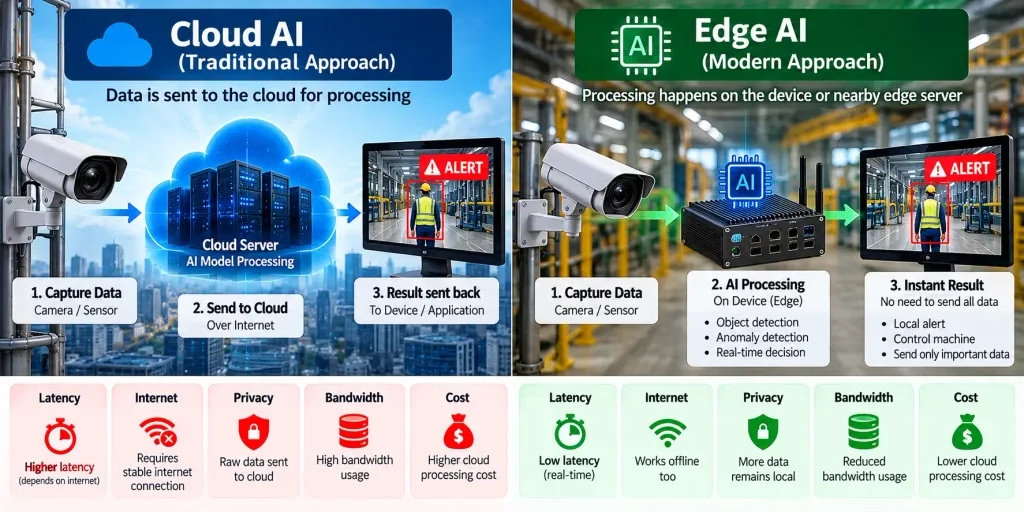
Traditional cloud-based AI generally sends data to a centralized cloud platform where an AI model processes it and returns a result.
For example, imagine a security camera monitoring a factory.
With a cloud-based architecture, the camera continuously sends video to a remote server. The server analyzes the video and determines whether a person, vehicle or unsafe event has been detected.
With Edge AI, an AI model can run directly on the camera or on a nearby edge computer.
The camera captures the image.
The local AI model analyzes it.
The system produces a result.
Only the important information may be sent to the cloud.
For example:
Person detected in restricted area.
Instead of continuously uploading the entire video stream, the system could send an event, timestamp, image or short video clip when something important happens.
This changes how an AI system can be designed.
Edge AI does not necessarily eliminate the cloud
This is an important distinction.
Edge AI is not about replacing cloud computing completely.
In many real-world systems, the edge and cloud work together.
The edge device can handle:
- Real-time inference
- Sensor processing
- Anomaly detection
- Local decision-making
- Data filtering
- Machine control
- Immediate alerts
The cloud can handle:
- Model training
- Long-term data storage
- Historical analytics
- Fleet management
- Dashboard
- Large-scale reporting
- Model updates
A practical architecture therefore looks more like:
Sensors → Edge AI → Local Decision → Cloud Platform → Analytics
rather than choosing between edge and cloud as if only one can exist.
Why Is AI Moving From Cloud to Devices?
The biggest reason is simple:
Data is being generated everywhere.
Factories have sensors.
Cars have cameras, radar and LiDAR.
Hospitals have connected medical equipment.
Retail stores have cameras and IoT devices.
Homes have smart speakers, cameras and appliances.
Industrial machines can generate thousands or millions of sensor readings.
Sending all this data to the cloud for every decision creates several challenges.
1. Latency
Latency is one of the strongest reasons for using Edge AI.
Suppose a machine-learning system is monitoring a high-speed manufacturing machine.
If the system detects a dangerous vibration pattern, waiting for:
Sensor → Internet → Cloud → AI → Internet → Machine
may introduce unnecessary delay.
An edge computer can process the sensor data locally.
Sensor → Edge AI → Action
For applications such as industrial safety, robotics, autonomous systems and machine control, that difference can matter.
Edge AI allows decisions to happen closer to the physical process.
2. Internet Connectivity
Cloud AI normally depends on network connectivity.
If the internet connection goes down, communication with the cloud may stop.
That can be inconvenient for a smart home device.
It can be much more serious in an industrial environment.
Imagine a remote manufacturing plant where the internet connection is unstable.
The machine should not necessarily stop making decisions simply because the cloud connection disappeared.
An Edge AI system can continue operating locally.
The device can make decisions even when the connection to the central platform is temporarily unavailable.
When connectivity returns, the device can synchronize important data with the cloud.
This is especially useful for:
- Remote factories
- Oil and gas facilities
- Mining sites
- Agricultural equipment
- Transportation
- Offshore installations
- Rural infrastructure
3. Privacy
Another important advantage of Edge AI is data privacy.
Consider a smartphone camera or a security camera.
Not every piece of raw data needs to leave the device.
If an AI model can process information locally, the system may only need to transmit the result.
For example:
Instead of uploading an entire audio recording, a device might detect a specific command locally.
Instead of uploading continuous camera footage, a system could send only an event when a predefined object is detected.
This can reduce the amount of sensitive information leaving the device.
However, Edge AI does not automatically guarantee privacy.
Developers still need to consider:
- Device security
- Encryption
- Authentication
- Secure model storage
- Firmware security
- Access control
- Data retention
Edge processing can reduce exposure, but it does not remove the need for cybersecurity.
4. Lower Bandwidth Requirements
IoT devices can generate enormous amounts of data.
Consider a factory containing hundreds of cameras and thousands of sensors.
Sending every raw reading and video stream to the cloud continuously could consume a significant amount of network bandwidth.
Edge AI can act as a filter.
For example:
A vibration sensor produces continuous data.
The edge device analyzes the signal.
Most normal readings can remain local.
If an unusual pattern appears, the system can send:
- Timestamp
- Machine ID
- Vibration level
- Anomaly score
- Relevant frequency information
- Short raw-data window
The cloud receives useful information instead of an endless stream of raw data.
This can significantly change the architecture and economics of an IoT system.
5. Reduced Cloud Processing Costs
Cloud computing is powerful, but processing large amounts of data continuously can become expensive.
Suppose 1,000 machines generate sensor data every second.
If every reading is uploaded and processed centrally, the infrastructure needs to handle:
1,000 machines × continuous data generation × 24 hours × 365 days
Now imagine increasing the deployment to 10,000 machines.
The data volume grows rapidly.
Edge AI can perform an initial analysis locally.
Only useful information is sent upstream.
This doesn’t mean cloud costs become zero.
Instead, the workload can be distributed more intelligently.
How Does Edge AI Actually Work?
An Edge AI system usually contains several components.
1. Sensors
Sensors collect information from the physical environment.
Examples include:
- Temperature sensors
- Vibration sensors
- Pressure sensors
- Cameras
- Microphones
- Accelerometers
- Energy meters
- Proximity sensors
- GPS
- Humidity sensors
2. Edge Device
The edge device processes the incoming data.
It could be:
- Industrial PC
- Raspberry Pi
- NVIDIA Jetson device
- AI accelerator
- Smart camera
- Smartphone
- Gateway
- Embedded controller
3. AI Model
The trained model performs inference.
For example:
- Object detection
- Image classification
- Anomaly detection
- Predictive maintenance
- Speech recognition
- Forecasting
4. Local Application
The application decides what to do with the model output.
For example:
Vibration anomaly detected → trigger warning → notify operator.
5. Cloud Platform
The cloud can store historical data, manage devices and provide dashboards.
This creates a complete edge-to-cloud architecture.
Edge AI vs Cloud AI
The difference becomes easier to understand with a simple comparison.
| Feature | Edge AI | Cloud AI |
|---|---|---|
| Processing location | Device or nearby edge server | Remote cloud/data center |
| Latency | Usually very low | Depends on network |
| Internet dependency | Lower | Higher |
| Privacy | More data can remain local | Data often sent to cloud |
| Bandwidth usage | Can be reduced | Can be high |
| Compute resources | Limited | Very high |
| Model size | Often optimized | Can support very large models |
| Maintenance | Distributed devices | Centralized infrastructure |
| Best suited for | Real-time decisions | Large-scale processing |
Neither architecture is universally better.
The right choice depends on the application.
What Is On-Device AI?
You may also hear the term On-Device AI.
On-device AI is a type of Edge AI where the AI model runs directly on the device.
A smartphone is a good example.
Modern phones contain processors designed to accelerate AI workloads.
Instead of sending every request to a remote server, certain AI features can run locally.
This can improve responsiveness and reduce network dependency.
The same concept can be applied to:
- Cameras
- Wearables
- Industrial gateways
- Robots
- Drones
- Vehicles
- Smart appliances
The important idea is that the intelligence is physically closer to the data source.
Edge AI in Industrial IoT
This is where Edge AI becomes particularly interesting.
Industrial environments already generate huge amounts of machine data.
A modern factory can have:
- PLCs
- SCADA systems
- Energy meters
- Vibration sensors
- Temperature sensors
- Pressure sensors
- Industrial gateways
- Cameras
- Robots
- Production counters
Traditional IoT systems collect this information and send it to a centralized platform.
Edge AI adds another layer.
Instead of simply collecting data, the edge device can analyze it.
For example:
Vibration Sensor → Edge Gateway → AI Model → Machine Health Score
The gateway might identify patterns associated with:
- Bearing problems
- Mechanical looseness
- Misalignment
- Unbalance
- Abnormal vibration
The system could then send an alert to the cloud dashboard.
This creates a predictive-maintenance workflow.
Example: Edge AI for Predictive Maintenance
Imagine a motor operating continuously inside a factory.
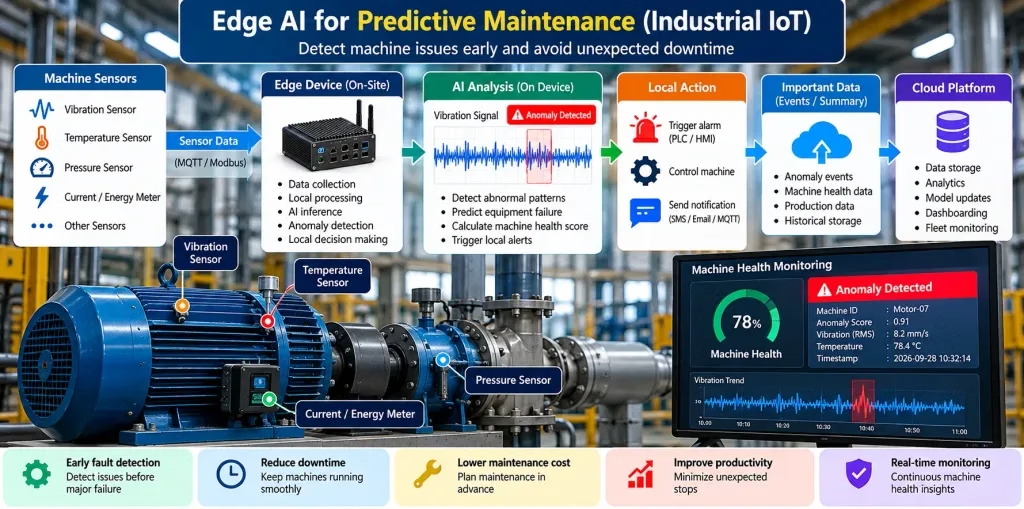
A vibration sensor collects data from the motor.
Without Edge AI:
Sensor → MQTT → Cloud → Database → AI Processing → Alert
With Edge AI:
Sensor → Edge Gateway → AI Inference → Alert
The edge gateway can continuously analyze vibration patterns.
Suppose the AI model detects a pattern associated with abnormal machine behavior.
The gateway can immediately generate an event:
Machine: Motor-07
Status: Anomaly Detected
Anomaly Score: 0.91
Timestamp: 10:32:14
The cloud can then receive the event and store it for historical analysis.
This approach is especially useful when the machine needs a fast response.
Edge AI and MQTT
Edge AI also fits naturally into IoT architectures using protocols such as MQTT.
A typical architecture could look like this:
Sensors
   ↓
PLC / IoT Device
   ↓
MQTT
   ↓
Edge Gateway
   ↓
AI Inference
   ↓
Decision
   ↓
MQTT
   ↓
Cloud / IoT Platform
   ↓
Database
   ↓
Grafana / Dashboard
The edge gateway doesn’t necessarily need to send every raw sensor reading to the cloud.
It can perform preprocessing and inference first.
For example:
Temperature = 78.4°C
Vibration = 8.2 mm/s
Current = 14.7 A
The AI model might convert those values into:
Machine Health = 72%
Anomaly = TRUE
Risk = HIGH
The cloud then receives the information that matters.
Edge AI for Computer Vision
Computer vision is one of the most visible Edge AI applications.
Consider a manufacturing line where cameras inspect products.
A camera could capture every product moving through the production line.
Sending every image to a remote cloud server may introduce bandwidth and latency problems.
Instead, an edge computer can analyze the images locally.
For example:
Camera
   ↓
Edge AI Model
   ↓
Defect Detected?
   ↓
Yes → Reject Product
No  → Continue Production
The decision can happen almost immediately.
The cloud may receive only:
Production Line: 3
Product: ABC-102
Inspection: Failed
Defect: Surface Crack
Time: 11:42:31
This is much more efficient than continuously uploading every image.
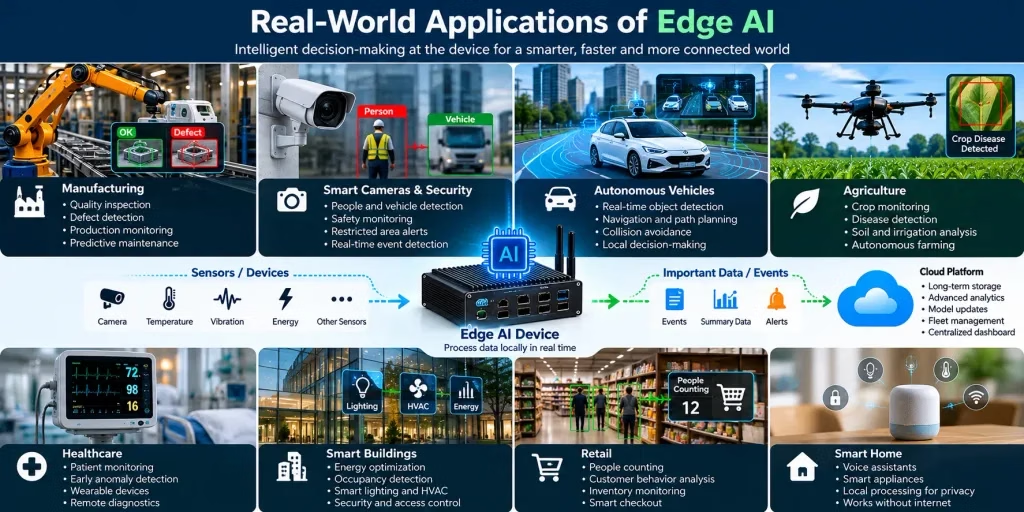
Edge AI in Smart Cameras
Traditional CCTV systems mainly capture and record video.
AI-powered cameras can understand what they are seeing.
For example, an edge AI camera could detect:
- People
- Vehicles
- Helmets
- Safety vests
- Smoke
- Fire
- Restricted-area entry
- Crowd density
- Missing safety equipment
Because the AI model can run directly on the camera or nearby edge hardware, the system doesn’t necessarily need to send the entire video stream to the cloud.
This is particularly useful in industrial safety applications.
Edge AI in Autonomous Vehicles
Vehicles are another strong example of why AI needs to operate close to the source.
A vehicle can generate information from:
- Cameras
- Radar
- LiDAR
- GPS
- Ultrasonic sensors
- Vehicle sensors
The vehicle cannot depend entirely on a remote cloud server for every immediate driving decision.
The system needs to process critical information locally.
For example:
Camera → Object Detection
Radar → Distance
LiDAR → Environment Mapping
       ↓
Local AI System
       ↓
Vehicle Decision
Cloud connectivity can still be useful for:
- Software updates
- Maps
- Fleet analytics
- Training data
- Diagnostics
But immediate decisions can happen locally.
Edge AI in Healthcare
Healthcare devices can also benefit from local AI processing.
Wearable devices can collect information such as:
- Heart rate
- Movement
- Sleep patterns
- Temperature
- Activity
An AI model can process some of this information directly on the device.
This can reduce the need to transmit raw data continuously.
Medical applications require particularly careful validation, security and regulatory compliance, so Edge AI should not be treated as automatically suitable simply because it is technically possible.
Edge AI in Agriculture
Agriculture is another area where edge computing can make a difference.
A smart agricultural system could use cameras and sensors to identify:
- Crop stress
- Soil conditions
- Irrigation requirements
- Plant diseases
- Pest activity
A field gateway can analyze sensor readings locally.
If an irrigation system detects that a particular area requires water, the local system can respond without waiting for a cloud request.
This can be valuable in locations where network connectivity is unreliable.
Why Edge AI Models Need to Be Smaller
There is a major difference between running an AI model inside a large data center and running one on an embedded device.
Cloud servers can have:
- Large GPUs
- Large amounts of RAM
- Powerful CPUs
- High-speed storage
- Significant power availability
An embedded device has much tighter constraints.
It may have:
- Limited RAM
- Limited CPU/GPU resources
- Battery constraints
- Limited storage
- Thermal limitations
Therefore, Edge AI models often need optimization.
Common techniques include:
Quantization
Quantization reduces the numerical precision used by a model.
For example, a model might move from higher-precision representations to lower-precision formats.
This can reduce memory usage and improve inference performance.
Pruning
Pruning removes less-important parts of a neural network.
The goal is to make the model smaller and faster while maintaining acceptable accuracy.
Knowledge Distillation
A large model, sometimes called the teacher, can help train a smaller model, called the student.
The smaller model can then be deployed on resource-constrained hardware.
Model Optimization
Frameworks and runtimes can optimize models for particular hardware.
This is important because AI performance depends not only on the model but also on the hardware and software stack.
Edge AI Hardware
Edge AI does not require one specific type of hardware.
Different applications use different platforms.
Examples include:
CPUs
Standard CPUs can run lightweight AI models.
They are useful when the model is relatively small and the processing requirements are moderate.
GPUs
GPUs are useful for parallel AI workloads.
They are commonly used in more demanding computer-vision and deep-learning applications.
NPUs
Neural Processing Units are specialized processors designed for AI workloads.
They are increasingly appearing in smartphones, laptops, cameras and embedded systems.
AI Accelerators
Dedicated AI accelerators can improve inference performance while potentially reducing power consumption.
Industrial PCs
Industrial PCs can provide more computing power for factory applications while operating in demanding environments.
Edge AI and 5G
5G and Edge AI are often discussed together, but they solve different problems.
Edge AI moves computation closer to the data source.
5G improves wireless connectivity.
Together, they can enable architectures where devices communicate with nearby edge infrastructure with relatively low latency.
For example:
Industrial Sensors
       ↓
5G Network
       ↓
Local Edge Server
       ↓
AI Inference
       ↓
Factory Application
The AI doesn’t necessarily need to run directly on every sensor.
It can run on a nearby edge server.
This is sometimes called multi-access edge computing (MEC).
Edge AI and Generative AI
Edge AI isn’t limited to traditional machine-learning models.
Generative AI is also moving toward smaller models that can run locally.
Large language models require significant computing resources, but smaller language models can sometimes operate on capable local hardware.
This opens possibilities such as:
- Local AI assistants
- Offline text processing
- Private document analysis
- Smart industrial assistants
- Voice interfaces
- Local summarization
However, there is a trade-off.
A smaller model running locally may have fewer capabilities than a much larger cloud model.
This is why hybrid architectures are becoming important.
A device could handle simple requests locally and send more demanding tasks to the cloud.
Hybrid AI: The Middle Ground
The future may not be purely edge or purely cloud.
Instead, many systems will use both.
For example:
                ┌── Local AI
                │
Device → Edge ──┤
                │
                └── Cloud AI
A simple request can be handled locally.
A complex request can be forwarded to the cloud.
This creates a flexible architecture.
For example:
Local:
- Detect object
- Detect anomaly
- Filter sensor data
- Trigger alarm
Cloud:
- Train model
- Analyze years of historical data
- Generate large reports
- Compare thousands of machines
- Manage the AI fleet
This division allows each environment to do what it is best suited for.
Challenges of Edge AI
Edge AI has many advantages, but it isn’t a magic solution.
There are several challenges.
Hardware Limitations
Edge devices have limited computing resources.
Developers must optimize models carefully.
Model Updates
Updating an AI model across thousands of devices can become complicated.
Companies need a reliable model deployment and version-management strategy.
Security
An edge device is physically closer to the outside world.
A cloud server may sit inside a highly controlled data center.
An industrial gateway might physically sit on a factory floor.
Attackers could potentially gain physical access to devices.
Therefore, secure boot, encrypted communication, authentication and secure firmware updates are important.
Monitoring
Managing one AI model in the cloud is relatively straightforward.
Managing 10,000 devices running different model versions is a different challenge.
Organizations need tools to monitor:
- Device health
- Model versions
- CPU usage
- Memory
- Inference latency
- Prediction quality
- Connectivity
Edge AI Security
Security deserves special attention because AI models are becoming part of physical systems.
A compromised edge device could potentially affect real-world operations.
Security practices should include:
- Secure device authentication
- Encrypted communication
- Secure boot
- Signed firmware
- Signed model packages
- Regular updates
- Access control
- Network segmentation
- Device monitoring
- Audit logs
For industrial systems, Edge AI should be integrated with the organization’s existing OT and cybersecurity strategy.
Is Edge AI Expensive?
The answer depends on the application.
An inexpensive microcontroller may be sufficient for a simple classification model.
A computer-vision system analyzing multiple high-resolution cameras could require significantly more powerful hardware.
The cost calculation should therefore include more than the hardware price.
Consider:
Hardware + Development + Deployment + Connectivity + Maintenance + Model Updates + Security
Sometimes Edge AI reduces cloud and bandwidth costs.
In other cases, the additional hardware may increase the initial investment.
The business case should be evaluated based on the entire system lifecycle.
When Should You Use Edge AI?
Edge AI makes particular sense when one or more of these conditions exist:
You need very low latency
If decisions need to happen quickly, local inference can help.
Internet connectivity is unreliable
The system can continue operating locally.
Data is sensitive
Processing information locally can reduce unnecessary transmission.
Bandwidth is expensive
The edge can filter and compress data before sending it upstream.
You have many IoT devices
Local processing can reduce the amount of data sent to central infrastructure.
The application involves physical control
Robots, machines and vehicles often need local decision-making.
When Cloud AI May Still Be Better
Cloud computing remains extremely useful.
Cloud AI can be preferable when:
- The model is extremely large
- Huge computing resources are required
- The application isn’t latency-sensitive
- Centralized processing is convenient
- Large historical datasets need to be analyzed
- Model training is required
For example, training a large AI model generally requires much more computing power than deploying the finished model to an edge device.
A common architecture is therefore:
Cloud trains the model → Edge runs the model
This is one of the most practical ways to combine both technologies.
The Future of Edge AI
The next phase of AI development will not simply be about making models bigger.
It will also be about making them smaller, faster, cheaper and more efficient.
As processors become more capable, AI inference will increasingly appear inside devices that previously had no AI capabilities.
We can expect Edge AI to become more common in:
- Industrial automation
- Smart factories
- Robotics
- Vehicles
- Drones
- Smartphones
- Wearables
- Security systems
- Agriculture
- Retail
- Energy management
- Smart buildings
The interesting part is that users may not even notice the transition.
AI will increasingly become a background capability of devices rather than something people explicitly access through a website or application.
Edge AI Is Not About Moving Everything Out of the Cloud
One of the biggest misconceptions about Edge AI is that companies have to choose between edge and cloud.
In reality, the strongest architecture may use both.
Think about a smart factory.
The edge can make immediate decisions:
“This machine is showing abnormal vibration.”
The cloud can answer larger questions:
“Which machines across all plants have shown similar patterns during the last 12 months?”
The first problem benefits from local processing.
The second benefits from centralized data.
Together, they create a much more useful system.
A Simple Edge AI Architecture for an IoT Project
If you are building an IoT system, a practical architecture could look like this:
┌─────────────────────────────┐
│          Sensors            │
│ Temperature | Energy | Vibration │
└──────────────┬──────────────┘
               │
               ↓
┌─────────────────────────────┐
│       Edge Gateway          │
│ Python / Node-RED / MQTT    │
└──────────────┬──────────────┘
               │
               ↓
┌─────────────────────────────┐
│        Edge AI Model        │
│ Anomaly / Classification    │
└──────────────┬──────────────┘
               │
        ┌──────┴──────┐
        ↓             ↓
   Local Alert     Important Data
                      │
                      ↓
              ┌───────────────┐
              │ Cloud Platform │
              │ Database      │
              │ Analytics     │
              └───────┬───────┘
                      ↓
                  Dashboard
For example, an industrial IoT gateway could receive MQTT data, preprocess the sensor values, run an anomaly-detection model and publish the result back through MQTT.
This approach allows the AI layer to become part of the existing IoT architecture instead of requiring a completely separate system.
Final Thoughts
AI started primarily in the cloud because cloud infrastructure provided the computing power required to train and run increasingly sophisticated models.
But the world generating the data is not inside the cloud.
It is in factories, vehicles, phones, cameras, machines, homes, hospitals, farms and industrial equipment.
That is why Edge AI is becoming increasingly important.
The basic idea is straightforward:
Bring intelligence closer to the data.
When a device can understand its environment locally, it can react faster, operate with less network dependency and potentially keep more data on-site.
The cloud isn’t disappearing.
Instead, the relationship between edge devices and cloud platforms is changing.
The future will likely involve a combination of:
Device + Edge AI + Cloud AI + IoT + Connectivity
And for developers working in IoT and industrial automation, understanding this architecture is becoming increasingly valuable.
Edge AI is not just another AI buzzword. It is a shift in where computation happens, and that shift could fundamentally change how intelligent connected systems are designed.