For the last few months, one term has been dominating AI discussions:
AI Agents.
Not chatbots.
Not just generative AI.
Not just ChatGPT.
AI Agents.
At first, I ignored the hype. I thought it was simply a new marketing word for existing AI tools. But after experimenting with agent-based workflows and automation systems, I realized something important:
AI is moving from answering questions to executing tasks.
And that is a massive shift.
In this detailed guide, I’ll explain:
- What AI agents really are
- How they work
- How they are different from ChatGPT
- Real-world use cases
- Whether they will replace jobs
- And why 2026 might be the breakthrough year
Let’s start from the basics.
What Exactly Is an AI Agent?
In simple words:
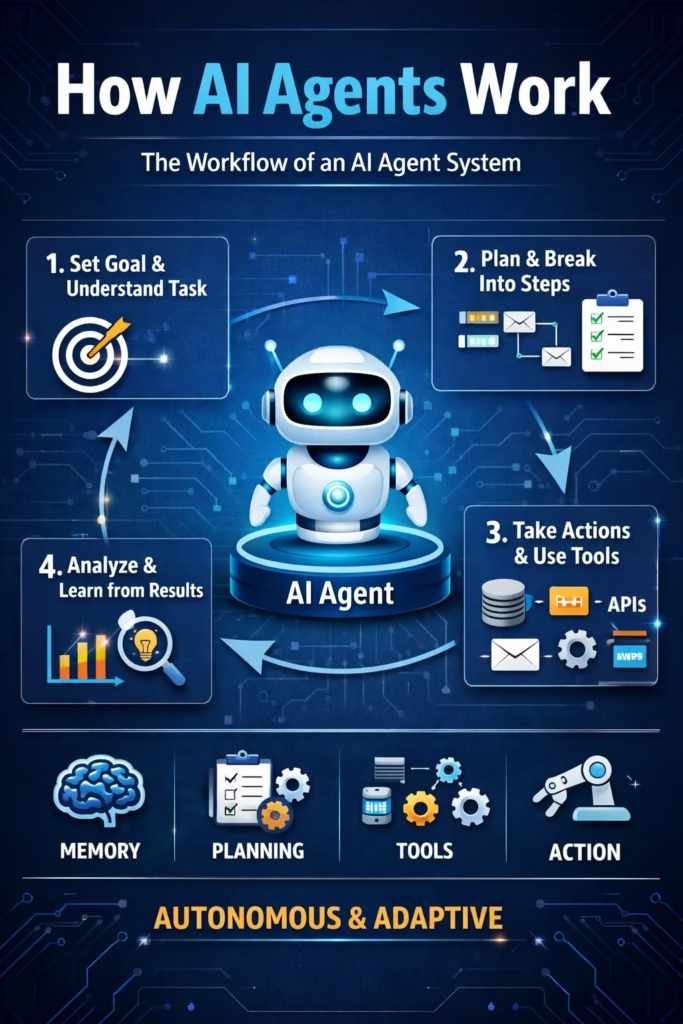
An AI Agent is a system that can understand a goal, plan steps, take actions, and adjust based on results — with minimal human intervention.
Unlike traditional AI models that respond when prompted, AI agents can:
- Set sub-goals
- Decide next actions
- Use external tools
- Execute workflows
- Monitor results
- Improve decisions
Think of it like this:
- ChatGPT is like a smart advisor.
- An AI Agent is like a junior employee who actually performs the task.
That’s the difference.
How AI Agents Work (Step-by-Step Explanation)
Let’s break it down technically but simply.
An AI agent system usually includes:
1. Large Language Model (Brain)
Most AI agents are powered by LLMs like those developed by
OpenAI.
The LLM handles reasoning and language understanding.
2. Memory
Agents maintain memory:
- Short-term memory (current task)
- Long-term memory (past decisions)
This allows them to improve over time.
3. Tool Access
Agents can connect to:
- Browsers
- Databases
- APIs
- Email systems
- Code environments
This is where the real power comes in.
4. Planning System
Instead of waiting for new prompts, the agent:
- Breaks a goal into smaller steps
- Executes step-by-step
- Evaluates output
- Adjusts if needed
This is what makes it autonomous.
AI Agents vs ChatGPT – The Real Difference
Many people think AI agents are just advanced chatbots.
They are not.
ChatGPT is primarily conversational.
Let’s compare clearly:
| Feature | ChatGPT | AI Agent |
|---|---|---|
| Answers questions | Yes | Yes |
| Generates content | Yes | Yes |
| Executes tasks | No | Yes |
| Connects tools | Limited | Yes |
| Works automatically | No | Yes |
| Multi-step reasoning | Limited | Advanced |
ChatGPT responds.
AI agents act.
That is the major evolution.
Real-World Example: Marketing Automation Agent
Imagine you run a small business.
You tell an AI agent:
“Launch a social media campaign for my product.”
The AI agent could:
- Research competitors
- Generate post ideas
- Design creatives
- Schedule posts
- Monitor engagement
- Adjust strategy
Without constant manual input.
That’s powerful.
Popular AI Agent Frameworks in 2026
Several experimental frameworks are shaping this space:
- AutoGPT
- BabyAGI
These projects showed how AI could:
- Self-prompt
- Plan tasks
- Execute code
- Iterate toward goals
Though early versions were unstable, they proved the concept works.
Where AI Agents Are Being Used Today
AI agents are not science fiction anymore.
Here are real applications.
1. Business Automation
Companies use AI agents for:
- Lead qualification
- Email filtering
- CRM updates
- Sales forecasting
- Customer support
Instead of hiring 5 interns, businesses deploy AI workflows.
2. Software Development
AI coding agents can:
- Write functions
- Debug errors
- Suggest architecture improvements
- Run test cases
- Deploy code
Developers are no longer coding alone.
3. Data Analysis
AI agents can:
- Pull data from dashboards
- Analyze trends
- Generate reports
- Send alerts
This reduces manual reporting work.
4. Personal Productivity
Some people use AI agents to:
- Plan daily schedules
- Summarize meetings
- Conduct research
- Organize notes
Think of it as a digital executive assistant.
My Personal Observation After Testing AI Agents
When I first tested AI agents, I expected fully autonomous performance.
Reality was different.
AI agents:
✔ Work well with clear objectives
✔ Perform repetitive tasks efficiently
✔ Save time in structured workflows
But they also:
❌ Make logical mistakes
❌ Loop unnecessarily
❌ Need supervision
❌ Can misinterpret vague instructions
So the technology is powerful — but still evolving.
Why AI Agents Are Trending in 2026
Search trends show a huge rise in queries like:
- “What are AI agents?”
- “AI agents vs ChatGPT”
- “How to build AI agent”
- “AI automation tools”
Why?
Because businesses want automation without complexity.
AI agents promise:
- Less hiring
- Faster execution
- Lower operational costs
- 24/7 productivity
That’s a strong value proposition.
Will AI Agents Replace Jobs?
This is the biggest concern.
Here’s the realistic answer:
AI agents will replace repetitive work — not creative or strategic thinking.
They may reduce:
- Data entry jobs
- Basic support roles
- Repetitive analysis work
But they will increase demand for:
- AI supervisors
- Automation engineers
- AI workflow designers
- Prompt engineers
So the shift is happening — but it’s not total replacement.
How Businesses Can Start Using AI Agents
If you want to integrate AI agents, start small.
Step 1: Identify repetitive tasks.
Step 2: Define a clear goal.
Step 3: Test with limited automation.
Step 4: Monitor results.
Step 5: Scale gradually.
Don’t try full automation immediately.
Future of AI Agents (2026–2028)
We may see:
- AI project managers
- AI marketing teams
- AI accounting assistants
- Autonomous AI trading bots
- AI DevOps managers
The next big shift in AI is not intelligence.
It’s autonomy.
Are AI Agents Safe?
AI agents can be safe if:
- Proper permissions are set
- Data privacy policies are followed
- Human oversight remains
Without monitoring, automation can cause errors.
Always keep a control layer.
Should Students Learn About AI Agents?
Absolutely.
Even if you don’t build them, understanding:
- How automation works
- How AI reasoning functions
- How workflows are structured
Will give you a competitive edge.
AI literacy will become as important as computer literacy.
Final Thoughts
When I first heard about AI agents, I assumed it was marketing hype.
After exploring automation systems and agent frameworks, I realized:
This is not just a feature upgrade.
It’s a new direction for artificial intelligence.
AI is moving from:
“Answering questions”
to
“Completing objectives.”
And that transition will redefine industries.
If you want to stay ahead in tech, understanding AI agents in 2026 is not optional.
It’s essential.
FAQ Section
1. What are AI agents in simple words?
AI agents are systems that can perform tasks automatically instead of just giving answers.
2. How are AI agents different from ChatGPT?
ChatGPT responds to prompts. AI agents can plan and execute multi-step tasks.
3. Are AI agents available for public use?
Some experimental frameworks exist, but most advanced systems are still evolving.
4. Do AI agents require coding knowledge?
Basic understanding helps, but no-code platforms are emerging.
5. Is AI agent technology growing?
Yes, AI agents are one of the fastest-growing AI trends in 2026.