Indian elections are massive. With millions of voters, thousands of polling stations, and long queues — managing everything manually was almost impossible. I still remember when I first saw an Electronic Voting Machine (EVM) during the 2014 Lok Sabha elections. That was the first time I understood how simple and fast voting could be when technology steps in.
Since then, I’ve been deeply curious about how an EVM machine actually works, especially because I work in IoT and automation. Over the years, I’ve read technical documents, watched demonstrations, and even discussed it with officers trained at election duty. So, in this post, I’ll explain EVM technology in the most simple, human, and experience-based way.
What Exactly Is an EVM?
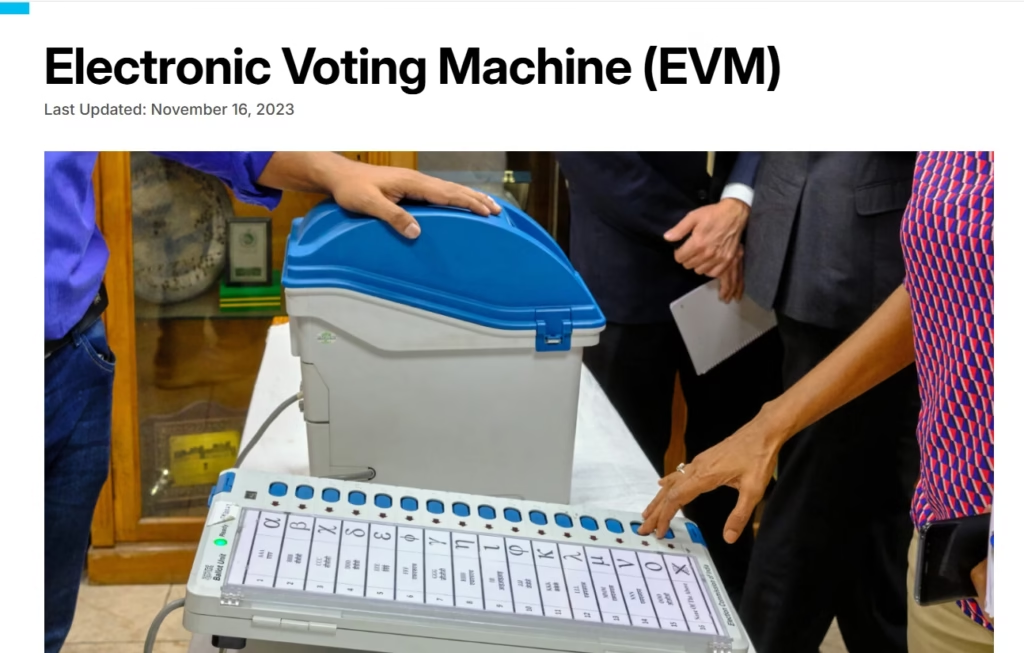
An Electronic Voting Machine (EVM) is a portable electronic device used to record votes during elections in India. The interesting part?
👉 It has no internet
👉 No Wi-Fi
👉 No Bluetooth
👉 No external connectivity
That means no remote hacking is possible.
EVMs were introduced to solve three big problems of the old paper ballot system:
- Fake ballot stuffing
- Invalid votes (torn paper, wrong stamp, double stamping)
- Slow counting (sometimes full night!)
The machine itself is very simple — that’s the beauty of Indian EVMs.
EVM Has Only Two Major Units
Balloting Unit (BU)
This is the unit where the voter presses the button. Inside the voting booth, you see:
- Candidate names
- Symbols
- Blue buttons
Control Unit (CU)
This unit stays with the polling officer. Votes are stored here.
Both are connected by a simple cable (around 5 meters long).
Step-by-Step: How Voting Happens Inside an EVM
Let me share this in the simplest experience-based style.
✔ Step 1: Voter enters
Polling officer checks ID and presses the BALLOT button on the Control Unit.
✔ Step 2: BU gets activated
The red light on the Control Unit blinks, and Balloting Unit becomes active.
✔ Step 3: Voter presses the button
When voter presses:
- A red LED glows
- A “beep” sound comes
This beep is important — it confirms your vote is recorded.
✔ Step 4: Vote stored securely
The vote goes straight into the Control Unit’s secure memory.
This memory is based on One-Time Programmable Microchip (OTP).
Meaning — once programmed, software cannot be changed or rewritten.
This is the biggest security feature!
How EVM Machine Stores Your Vote (Technical but simple)
EVM stores only:
- Candidate number (like candidate 1, 2, 3…)
- Total count
- Timestamp of pressing
But no identity of the voter.
I personally checked this with an Election Officer during training days and he confirmed that EVM has no mechanism to trace which voter pressed which button. This ensures privacy & democracy.
VVPAT: The Paper You See for 7 Seconds
In 2019, VVPAT was added to increase transparency.
When you press a button, you see:
- Candidate name
- Symbol
- Your selection printed on paper
The paper moves inside a sealed box automatically.
This VVPAT paper can be manually counted later for verification.
This brought huge trust among voters.
Why EVM Cannot Be Hacked? (Very Real Explanation)
I often hear “EVM hack ho sakta hai?”
But when you understand the technology, hacking is almost impossible.
Here’s why:
✔ No internet = No remote attack
The machine is completely offline.
✔ OTP microcontroller
Software cannot be rewritten after manufacturing.
✔ Physical seals & signatures
After sealing during polling, if the seal is broken, machine gets rejected.
✔ Random machine allocation
EVMs are randomly allotted to booths just before elections using computer-based randomization.
No one knows which machine goes where.
✔ 3-tier protection system
- Technical team verifies
- Political party agents verify
- Election Commission verifies
Even if someone tries to change one machine, thousands of cross-check layers will detect it.
How Counting Happens So Fast
One of the most magical parts of EVM is fast counting.
I once visited a counting center in Gurgaon and saw how officers opened the Control Unit.
Steps:
- Officials press RESULT button.
- Candidate-wise votes show on the screen.
- Results are written in EVM Result Sheet.
- VVPAT slips may be matched randomly.
And that’s it.
A process that used to take hours earlier now takes a few minutes.
Is EVM Safe? My Honest Conclusion
After reading official documents, watching demonstrations, and personally seeing the machines at polling booths, I can say:
👉 EVM works on simplicity, not complexity
And that simplicity makes it nearly impossible to compromise.
👉 More than 20+ years and billions of votes
No proven hacking report exists.
👉 VVPAT gives full transparency
Even a single mismatch creates strict legal actions.
EVM is not just a machine. It is the backbone of the world’s largest democracy.
You can also learn how technology works in IoT communication in this post on my website:
https://techknowledge.in/how-i-send-iot-data/
Election Commission of India – EVM Info: https://eci.gov.in/evm/
Frequently Asked Questions (FAQ)
1. What is the main purpose of an EVM?
To record votes electronically and eliminate problems like invalid votes, ballot stuffing, and slow counting.
2. Can anyone hack an EVM?
Practically no. EVM has no internet, no Wi-Fi, and uses OTP microchips that cannot be reprogrammed.
3. What is VVPAT?
VVPAT shows a printed slip of your vote for 7 seconds, which is then stored in a sealed box for verification.
4. How many votes can one EVM store?
An EVM can store up to 2000 votes per ballot unit.
5. What happens if electricity goes off?
EVMs run on high-quality batteries, not electricity. Power cuts don’t affect them.
6. Who manufactures EVMs in India?
ECIL and BEL, both government-owned companies.
7. How does counting happen?
Officials press the RESULT button on Control Unit and results display instantly.