A few years ago, I used to think smart homes were just for tech geeks or luxury villas. My mindset changed slowly — first with a smart bulb, then a plug, then security cameras. Before I knew it, half my house was automated.
Now in 2025, I can genuinely say this Best Smart Home Gadgets of 2025 – Real User Experience & Guide is not based on YouTube hype or sponsored reviews. Everything I’m sharing here comes from real daily use, real electricity bills, real security situations, and real mistakes I made while building my smart home.
Smart homes are no longer:
- Expensive
- Unreliable
- Complicated
Instead, they’re:
- Energy efficient
- Safer
- More comfortable
- Family friendly
If you’re also curious about how smart technology is shaping the future and what risks come with it, I strongly recommend you read this detailed guide on IoT trends:
https://techknowledge.in/iot-in-2025-opportunities-and-risks/
Now let’s go step-by-step into the Top 10 Best Smart Home Gadgets of 2025 that truly matter in real life.
1. Smart AI Home Assistant – The Brain of My Entire House
Your smart home is only as smart as its brain. For me, this role is handled by devices like Amazon Echo Show 15 and Google Nest Hub Max.
These are not just speakers anymore. In 2025, they act as:
- Full automation control centers
- Family planners
- Security dashboards
- Energy monitoring screens
- Video calling devices
- Emergency alert panels
My Real Experience:
Earlier, I had to open multiple apps to control different devices. Now I just say:
“Turn off bedroom lights and lock main door.”
And everything happens together.
It has even learned my routine:
- Opens curtains at sunrise
- Turns off TV at midnight
- Adjusts AC automatically
- Switches off unused power plugs
This single upgrade made my home truly smart, not just connected.
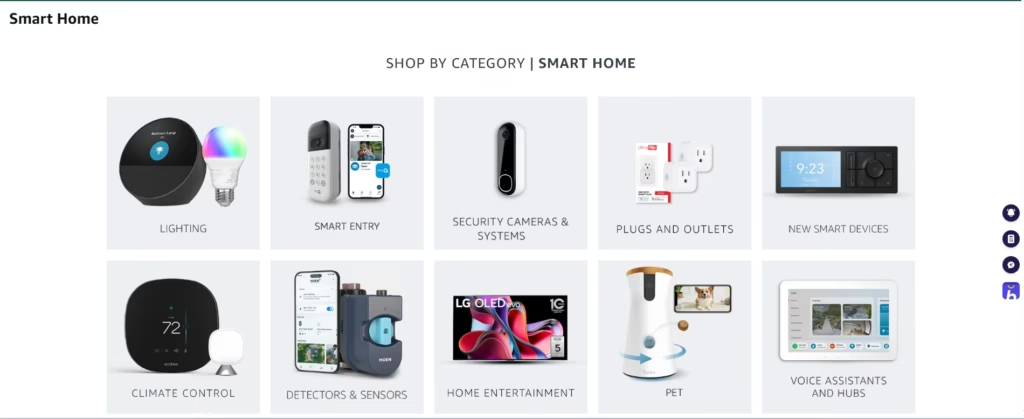
2. Smart Security Cameras with AI Motion Detection
This is the first category I recommend to anyone starting their smart home journey.
Brands like Ring and Arlo dominate this space in 2025.
Key Features I Use Daily:
- Human detection vs object AI
- Mobile alerts in real time
- Two-way audio
- Night vision with color mode
- Edge + cloud recording
- Emergency siren
Real-Life Benefit:
Earlier I used to get false alerts for cats, shadows, and rain. In 2025, false alerts are almost gone. The AI only notifies me when a real person enters my detection zone.
Once I even identified a stranger trying door handles using camera playback. That itself justifies the investment.
3. Smart Video Doorbell – Personal Security Guard at the Door
A smart doorbell may look small, but it delivers huge value.
With it, I can:
- See visitors live
- Talk to delivery boys remotely
- Detect suspicious movement
- Record 24×7
- Store clips locally or cloud
Once, while I was in the office, I accepted a courier delivery and told the delivery guy where to keep the package. That convenience alone feels futuristic.
4. Smart Door Lock – Goodbye Physical Keys
Convincing my family to switch to a smart lock was difficult. Now they don’t want to go back.
Today’s smart locks offer:
- Fingerprint access
- PIN unlock
- Mobile app access
- Temporary guest passwords
- Auto-lock safety
- Intrusion alerts
Real Advantage:
No more lost keys
No more duplicate keys
Full access history
Better child safety
Better elder access
It feels more secure than traditional locks because it notifies me instantly if someone tries forced access.
5. Smart Lighting System – Comfort + Mood + Energy Saving
Smart lights in 2025 are not just RGB color toys. Using systems like Philips Hue, I now enjoy:
- Auto brightness control
- Motion-activated lighting
- Circadian rhythm lighting
- Night-mode automation
- Vacation simulation lighting
Electricity Savings:
After 6 months of use, I noticed nearly 20% drop in lighting electricity usage.
Lights turn off automatically when nobody is inside the room. That alone cut unnecessary wastage.
6. Smart Thermostat – Silent Money Saver
Before using a smart thermostat, AC usage was fully manual. I used to forget switching it off many times.
Now the system:
- Learns my cooling habits
- Adjusts temperature automatically
- Responds to weather changes
- Switches to eco-mode when I leave home
- Sends monthly power usage reports
I realized AC energy usage dropped by nearly 15–18% without sacrificing comfort.
7. Smart Plugs & Energy Monitoring Sockets
These are underrated but powerful devices.
I personally use them for:
- Water heater
- Geyser
- Refrigerator
- Washing machine
- Router
- TV & sound systems
They allow me to:
- See live power usage
- Set auto-off schedules
- Cut standby power loss
- Detect faulty appliances
Once I discovered my old water heater was wasting power even when turned off. That alone saved me money monthly.
8. Smart Robot Vacuum & Mop – Daily Dust Manager
Robot vacuum cleaners in 2025 have become extremely intelligent.
They:
- Create full 3D maps of your home
- Detect obstacles
- Avoid cables
- Adjust suction automatically
- Mop and vacuum together
- Self-empty dust bins
Honest Review:
It does NOT replace deep cleaning.
But it removes daily cleaning stress completely — especially for working families.
9. Smart Curtains & Window Blinds – Luxury That Makes Sense
This started as a luxury purchase, but now I realize its real value.
My curtains:
- Open automatically at sunrise
- Close during peak heat
- Sync with movie scene modes
- Close automatically at night for privacy
Now I wake up naturally with sunlight instead of phone alarms.
10. Whole Home Automation Hub – The Backbone of Everything
Without a central automation hub, your smart home becomes messy.
With a proper hub:
- All devices talk to each other
- Automations become faster
- Network load reduces
- Security improves
- Fewer app dependencies
Once I centralized everything under one automation hub, real reliability started.
For global trends, growth data, and smart home adoption statistics, you can also explore:
🔗Click Here
What I Learned After Living with Smart Devices Daily
Here are 10 real lessons from daily use:
- Automation saves real time daily
- Energy tracking saves monthly bills
- Security gives mental peace
- Voice control helps elders
- Good WiFi is more important than devices
- Cheap gadgets fail early
- Cybersecurity cannot be ignored
- Local backup power is important
- Updates maintain stability
- Not everything needs to be smart
Common Smart Home Mistakes People Make
- Buying too many gadgets together
- Mixing incompatible ecosystems
- Weak WiFi routers
- No UPS for hub
- Using default passwords
- Ignoring firmware updates
- No manual control fallback
- No automation rules
- Too many brand apps
- No device grouping
Is a Smart Home Really Worth It in 2025?
From pure personal experience — Yes, absolutely.
Not for show, but because:
- It actually reduces electricity waste
- It increases home safety
- It adds comfort
- It makes daily routines smoother
- It helps elders & children
- It improves sleep cycles
- It adds remote control convenience
- It prepares your home for the future
Final Verdict
After using automation daily, I confidently say this Best Smart Home Gadgets of 2025 – Real User Experience & Guide is built on practical value, not marketing hype. Smart homes are no longer futuristic experiments. They are now stable, reliable, secure, and genuinely useful.
If you plan automation:
- Start small
- Buy quality devices
- Build slowly
- Focus on real needs, not trends
Frequently Asked Questions (FAQ)
1. Are smart home devices safe in 2025?
Yes, if you use strong passwords, firmware updates, encrypted WiFi, and branded products.
2. Do smart homes raise electricity bills?
No. In most cases, they reduce power usage with automation and monitoring.
3. Can smart devices work without internet?
Basic local automation works. Remote access and AI features require internet.
4. What is the minimum budget for a smart home in India?
A basic setup can start from ₹8,000–₹15,000 and scale upward.
5. Why follow the Best Smart Home Gadgets of 2025 – Real User Experience & Guide?
Because this guide is not sponsored. It is built from real daily use, mistakes, savings, and security experiences.
Final Closing Note
Smart homes don’t replace humans — they silently support us. They reduce small daily frustrations that we normally accept as “normal life.” In 2025, automation is no longer about showing off gadgets. It’s about building a peaceful, efficient, and secure lifestyle.